
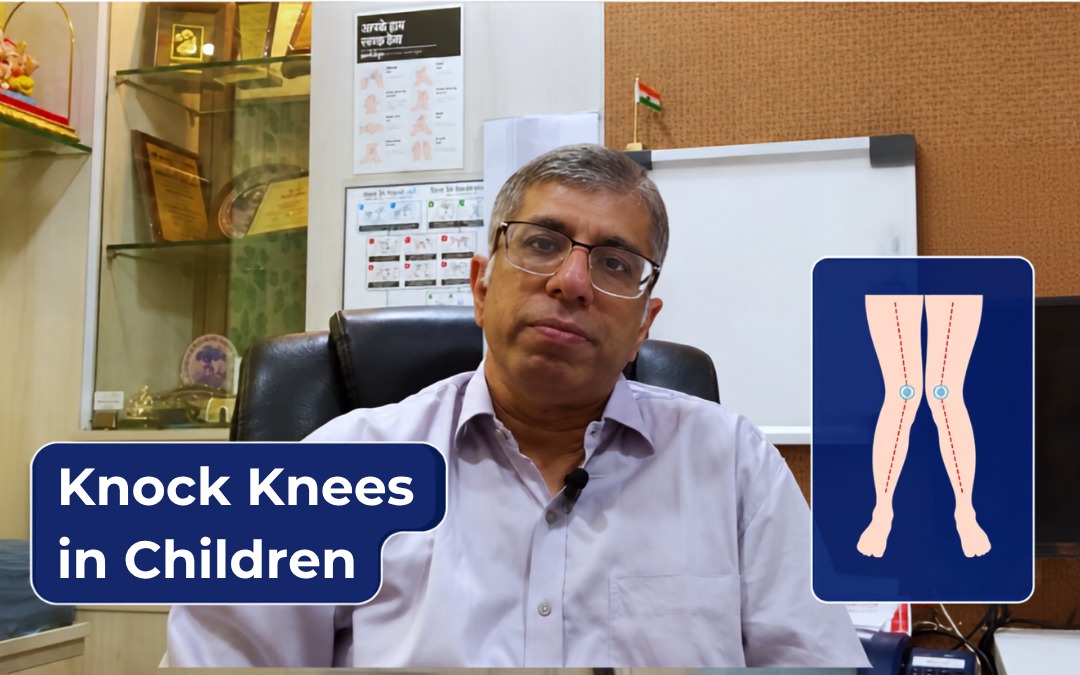
Knock knees are a concern many parents notice as their child grows. While it may look unusual, in most cases, it is a natural part of development. However, there are situations where it requires closer attention and timely treatment at a trusted orthopaedic hospital in Thane or by an experienced pediatric orthopaedic surgeon in Thane.
It is important to understand that knock knees are not always a problem—but knowing when they are can make a significant difference in your child’s long-term joint health.
What Are Knock Knees?
Knock knees, medically known as genu valgum, is a condition where the knees come closer together while the ankles remain apart.
In a normal alignment:
- The legs are straight
- Knees and ankles align properly
In children with knock knees:
- The knees touch or come close together
- A noticeable gap appears between the ankles
This creates an inward angle at the knees, giving the legs a “knocked” appearance. Early diagnosis by a pediatric orthopaedic specialist can help determine if it is a normal growth phase or something that needs intervention.
Is It Normal in Children?
This is one of the most common questions parents ask. The answer is—yes, in many cases it is completely normal.
Children go through natural growth phases:
- Up to age 5 years → Knock knees are usually physiological (normal)
- Between 5–8 years → Legs gradually start straightening
- By 7–8 years → Most children achieve normal alignment
This is simply a part of how bones grow and develop. Regular checkups with an orthopaedic doctor can reassure parents during this phase.
When Should Parents Be Concerned?
While early knock knees are normal, certain signs require medical attention:
- Knock knees persist beyond 8 years of age
- The condition appears after 8 years
- The gap between ankles is increasing over time
- The child has pain, difficulty walking, or frequent falls
- There is asymmetry (one leg more affected than the other)
In such cases, consultation with a pediatric orthopaedic surgeon in Thane is strongly recommended.
Why Is Early Evaluation Important?
If significant knock knees are left untreated:
- Excess stress is placed on the knee joint
- Abnormal alignment affects walking mechanics
- Over time, this may increase the risk of early knee arthritis
Early identification helps prevent long-term complications and ensures proper joint function.
Can Knock Knees Be Treated?
Yes—and very effectively, especially when addressed at the right time.
Treatment depends on the child’s age and severity of the condition.
For Younger Children (Growth Remaining)
A commonly used method is guided growth (Eight Plate Surgery):
- Small plates are placed near the knee
- These plates guide bone growth gradually
- The legs straighten naturally over time
This procedure is:
- Minimally invasive
- Safe
- Highly effective
For Older Children (Near or After Growth Completion)
In teenagers or older children, a procedure called osteotomy may be required:
- The bone is realigned surgically
- Corrects the deformity and restores proper alignment
This is a well-established and successful treatment option.
Moving Forward with Confidence
Knock knees in children are often a normal phase—but not always. With timely evaluation:
- Normal alignment can be restored
- Long-term joint damage can be prevented
- Children can continue to grow, play, and move confidently
If you notice:
- Persistent knock knees after age 8
- Increasing deformity
- Difficulty in walking or activity
It is advisable not to wait. Early consultation with a pediatric orthopaedic surgeon can ensure the best possible outcome for your child.
Your child’s growing bones are highly responsive to treatment when addressed at the right time. What may seem like a small concern today can have long-term implications if ignored.
Our goal is simple — to support healthy growth and preserve strong, pain-free movement for your child’s future.
To know more about the management of knock knees in children, fix an appointment with our Orthopaedic / Pediatric Orthopaedic Department.
This blog post has been published for patient information purposes by Pinnacle OrthoCenter Hospital.
For more information, contact us at: 02240763000 / 7028859555
FAQs
- Do knock knees correct themselves in children?
Yes, in most children under 7–8 years, knock knees are a normal developmental phase and usually correct on their own without treatment. - At what age should I worry about knock knees?
If knock knees persist after 8 years of age or worsen over time, it is important to consult a pediatric orthopaedic specialist. - Is surgery always required for knock knees?
No. Surgery is only needed in moderate to severe cases. Many children improve naturally or with guided growth treatment. - What is the best treatment for knock knees in children?
For younger children, guided growth (Eight Plate Surgery) is highly effective. Older children may require corrective surgery like osteotomy. - Can knock knees cause problems later in life? Yes, if untreated, severe knock knees can lead to joint stress, improper walking patterns, and early arthritis.

0 Comments