
Knee replacement surgery is something that many patients feel anxious about before undergoing the procedure.
When patients come to us for knee replacement surgery, they often have many questions and doubts in their minds regarding the surgery and the possible risks involved.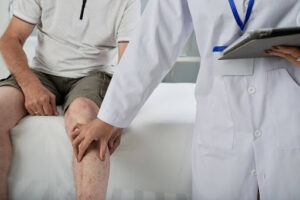
The most common concerns patients have are:
- Will I be able to walk properly after surgery?
- How much pain will I experience after surgery?
- What are the risks and complications associated with knee replacement surgery?
These concerns are very natural and understandable.
Fortunately, with modern surgical techniques, advanced anesthesia, robotic-assisted technology, and proper post-operative care, knee replacement surgery today is much safer and more successful than before.
In this article, Dr. Yogesh Vaidya, Senior Robotic Joint Replacement Surgeon at Pinnacle Ortho Centre Hospital, Thane, explains the common risks and complications associated with knee replacement surgery and how they are managed effectively.
What are the Risks Involved in Knee Replacement Surgery?
Like every surgery, knee replacement surgery also carries certain risks and complications.
However, these risks are usually minimal and should not discourage patients from undergoing surgery when it is medically needed.
Certain complications can occur during the surgery itself, such as:
- Minor anesthesia-related complications
- Soft tissue injury around the knee joint
- Injury to blood vessels or surrounding structures
- Bleeding during surgery
But with expert anesthesiologists, experienced surgeons, advanced surgical techniques, and robotic-assisted technology, these intraoperative complications are minimized significantly.
Infection After Knee Replacement Surgery
Infection is one of the most important complications doctors monitor after knee replacement surgery.
Although uncommon, infection can occur even in the best hospitals and with experienced surgical teams worldwide.
Infections may occur:
- Immediately after surgery
- Or even years later as delayed infections
Early infections are usually treated with antibiotics, wound cleaning procedures, and sometimes liner exchange surgery.
In more severe cases, patients may require long-term antibiotic treatment to completely eliminate the infection.
In some cases, patients may need to undergo another procedure where:
- The wound is cleaned thoroughly
- The liner component is exchanged
- Long-term antibiotics are started
Deep Infection & Biofilm Formation
Sometimes, the infection becomes deep-seated and forms something called a biofilm.
In a biofilm, microorganisms create a protective layer over the implant, making it difficult for antibiotics to completely remove the infection.
In such situations, a two-stage revision surgery may be required.
First Stage Surgery
During the first stage:
- The infected implant is removed
- Thorough cleaning and debridement is performed
- An antibiotic spacer is placed
- IV antibiotics followed by oral antibiotics are given
Second Stage Surgery
Once we are sure that the infection has completely cleared, usually after 2–3 months, a second knee replacement surgery is performed.
With advanced antibiotics and modern revision techniques, the results of two-stage surgeries are excellent, and patients can return to their normal activities and lifestyle.
Delayed Infection After Knee Replacement
Sometimes infection may develop a few years after surgery.
This can happen because of hematogenous spread of infection, where infection travels through the bloodstream from another part of the body.
Common sources include:
- Dental infections
- Urinary tract infections
When delayed infection occurs, patients may again require revision surgery similar to the two-stage procedure discussed earlier.
This is why it is very important for patients with knee replacement implants to treat infections anywhere in the body at an early stage.
Deep Vein Thrombosis (DVT)
Another important complication after knee replacement surgery is Deep Vein Thrombosis (DVT).
What is DVT?
After surgery, patients may remain less active for a short period.
This can lead to pulling of blood in the veins of the legs, causing blood clots to form.
In rare situations, these clots can travel to the lungs and cause a serious condition called Pulmonary Embolism, which can become life-threatening.
How Do We Prevent DVT?
First is the early ambulation of the patient. We typically mobilize the patient within a few hours of surgery. We try to get them up and about as early as possible. So once the patient is mobilized, once they start moving their lower limb muscles, the risk of DVT is definitely decreased.
We use:
- Anti-embolism stockings
- Flowtron pumps
These devices help improve blood circulation in the lower limbs while the patient is resting in bed.
Blood Thinners
Certain medications are also prescribed to prevent clot formation, such as:
- Low molecular weight heparin injections
- Oral anticoagulant medications
With these preventive measures, the risk of DVT is reduced significantly.
Should These Risks Stop You from Undergoing Surgery?
Every surgery, whether small or major, carries certain risks and complications.
However, these risks should not prevent patients from undergoing knee replacement surgery when it is required.
Today, with:
- Advanced robotic technology
- Better surgical precision
- Improved infection control
- Modern anesthesia techniques
- Early rehabilitation protocols
knee replacement surgery has become a highly successful and safe procedure.
When Should You Consult a Joint Replacement Surgeon?
You should consult a specialist if you experience:
- Severe knee pain
- Difficulty walking
- Trouble climbing stairs
- Knee stiffness
- Swelling in the knee joint
- Reduced quality of life due to arthritis
Early evaluation helps in proper diagnosis and timely treatment.
Why Choose Pinnacle Ortho Centre Hospital?
At Pinnacle Ortho Centre Hospital, patients receive comprehensive orthopedic care with advanced technology and personalized treatment plans.
Frequently Asked Questions (FAQs)
Q1. Is knee replacement surgery safe?
Yes, knee replacement surgery is considered a safe and highly successful procedure when performed by experienced surgeons using modern techniques.
Q2. Will I be able to walk after knee replacement surgery?
Most patients are able to stand and walk within a few hours to one day after surgery with the help of physiotherapy.
Q3. What is the most common complication after knee replacement?
Infection and blood clot formation (DVT) are among the commonly discussed complications after surgery.
Q4. Can infection happen years after knee replacement?
Yes, delayed infections can occur if infection spreads through the bloodstream from another part of the body.
Q5. What is a two-stage revision surgery?
It is a procedure where the infected implant is removed first and a new implant is placed after the infection is completely treated.
Q6. How is DVT prevented after surgery?
DVT is prevented using early walking, compression devices, and blood thinner medications.
Q7. Is robotic knee replacement better?
Robotic-assisted surgery improves surgical precision, implant positioning, and overall accuracy during knee replacement surgery.
For expert consultation regarding robotic knee replacement surgery and arthritis treatment, consult Dr. Yogesh Vaidya at Pinnacle Ortho Centre Hospital, Thane.

0 Comments